


Managing a Multicultural Team: How to Adapt Your Management Style
Making a decision, delegating, settling a disagreement: the same managerial practice is not read the same way from one cultural context to another. Here is how to spot these gaps and adapt your management style.

One managerial practice, several cultural readings
Managing a multicultural team is not about finding the one style that works everywhere. That style does not exist. A managerial practice produces a different effect depending on how the team receives it, and that reception depends in part on the cultural context in which each person learned what a good manager looks like.
Take the most ordinary act of managerial life: making a decision. A manager who decides alone and announces the outcome may be seen as someone who fully owns the role. The same manager, in another context, may be seen as someone who bypasses the team and takes away its autonomy. Conversely, a manager who organizes a collective decision may be seen either as a leader who empowers people, or as a leader who will not own the role.
This kind of gap is anything but anecdotal. International teams, spread across several countries and time zones, have become the norm in a great many organizations. Managers have fewer informal signals than they would on site to correct course: a frown in a meeting, a hallway conversation afterwards, a hesitation picked up in time.
Nothing has changed in the manager’s behavior. What changes is the interpretive frame applied by those who observe it. That gap in interpretation is precisely what produces most of the friction in international teams, well before questions of language or time zones.
Four examples among the Nomad’ Profiler dimensions
To make this gap visible, it has to be broken down. The Nomad’ Profiler, the framework developed by Akteos, describes professional cultural preferences across ten dimensions. Four of them shed particular light on the question of managerial decision-making. They are presented below by contrasting the two ends of each axis, with a few countries positioned for illustration.
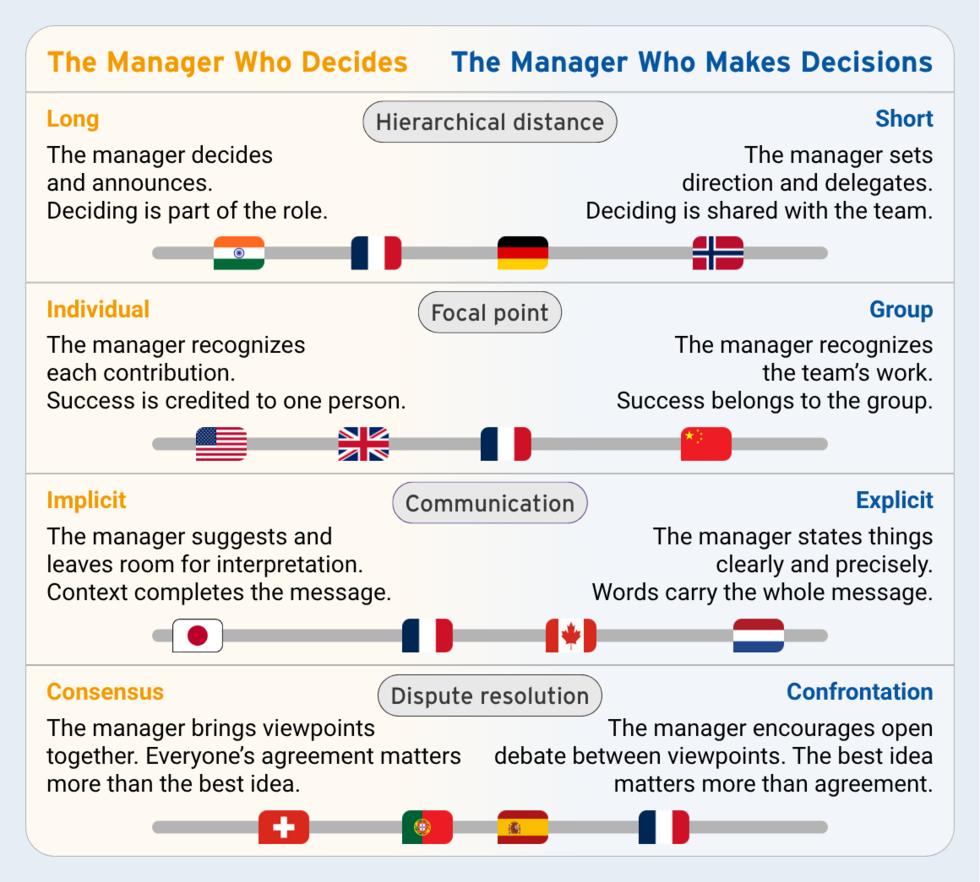
France appears on all four axes, which makes it a useful reference point. It never sits in the same place from one dimension to the next: rather toward a marked hierarchical distance, rather toward the collective on focal point, rather implicit on communication, rather toward opposition on dispute resolution. That is a first useful lesson: a culture cannot be reduced to a single position, and it is never closer to or further from another culture as a whole. Two teams can understand each other perfectly on one dimension and clash head-on on the next.
The positions shown reflect tendencies observed in professional contexts, not rules that apply to every individual. They serve to frame working hypotheses, never to predict individual behavior.
Hierarchical distance: who has the legitimacy to decide?
This dimension measures the importance given to hierarchy and the way authority is exercised. Where hierarchical distance is wide, deciding is an integral part of the manager’s role, and the team expects them to settle the matter. Where it is narrow, decision-making is shared more widely, and the manager is judged on their ability to set the frame and to delegate.
Focal point: who does success belong to?
This dimension reflects the place of the individual in relation to the group. Where the focal point is rather individual, naming a specific contribution is a lever for motivation. Where it is rather collective, singling out one person for a result achieved by several can make that person uncomfortable and weaken team cohesion.
Communication: what is said and what is understood
This dimension describes the respective weight of the explicit message and of the context. In a rather implicit mode, the manager suggests, and a significant part of the message travels through what is left unsaid, the situation, the relationship. In a rather explicit mode, everything that matters has to be spelled out, and what is not said is not meant to be understood.
Dispute resolution: consensus or opposition?
This dimension reflects the main objective pursued when points of view diverge. On one side, the aim is a solution all parties can live with, in order to preserve the harmony of the group: open conflict is prevented rather than confronted. On the other, the aim is the best solution, even if it means going through an acknowledged conflict: showing disagreement is accepted, and people defend their idea to the end.
What these gaps change in practice for a manager
These differences almost never show up as explicit disagreement. They show up as quiet, repeated misunderstandings that are hard to name.
A few situations that managers of international teams run into frequently:
- Silence in a meeting: a manager used to an explicit mode reads the absence of questions as agreement, when their counterparts were waiting to be asked individually.
- Delegation that falls flat: a manager deliberately leaves room for initiative in order to empower the team, but the team reads that room as vagueness, or even as disengagement on the manager’s part.
- Recognition that misses its mark: someone singled out by name in front of the group feels exposed rather than valued.
- Invisible disagreement: a decision approved without objection in a meeting leads to no action afterwards, because disagreement could not be voiced openly at that moment.
In each of these cases, the spontaneous explanation is usually individual: this person lacks initiative, this team lacks candor, this colleague is too sensitive. An intercultural reading offers another hypothesis, simpler and above all more actionable: expectations about the manager’s role are not the same on both sides.

Developing your Global Leadership
Broaden your managerial range, adjust your posture to different cultural contexts and increase your impact with international teams.
View our upcoming sessionsHow to adjust your posture without giving up who you are
Adapting your management style does not mean adopting someone else’s. A French manager who mechanically imitated an imported model would lose coherence, and therefore credibility. The point is to broaden your range and to choose consciously, rather than defaulting to what has worked so far. It also means remembering that a manager does not observe from a neutral vantage point: their own style is itself a situated profile, which their teams perceive and interpret through their own cultural frame.
A few concrete principles:
Observe before adjusting. Notice how decisions are actually made in the team, who speaks up, at what point, and what gets said after the meeting rather than during it.
Spell out your own rules of the game. Say what you expect, how you decide, what belongs to the team and what belongs to the manager. What seems obvious is never obvious to everyone.
Ask questions rather than interpret. Faced with surprising behavior, asking how the person would have proceeded in their usual context often yields more information than a long analysis.
Differentiate without categorizing. A national culture gives an average tendency, not an individual profile. Two people from the same country can sit at opposite ends of a dimension.
Own your trade-offs. Some practices are not negotiable, for legal, ethical or internal policy reasons. Spelling them out and explaining them is better than imposing them without comment.
Using a diagnostic tool to make the gaps objective
Intuition rarely suffices, because everyone spontaneously treats their own way of working as neutral. That is where a diagnostic tool becomes useful.
The Nomad’ Profiler allows managers to identify their own cultural preferences across the ten dimensions, then compare them with the average profile of a country or with the profiles of their team members. It is not a test of intercultural competence and says nothing about the quality of a manager: it is a measure of gap. And it is precisely the gap, not the absolute position, that produces misunderstandings.
This comparison can run in two directions. Against a country, it prepares a new posting or a collaboration with a subsidiary. Against the profiles of one’s own team members, it sheds light on the recurring tensions of an existing team, the ones that come back meeting after meeting without ever being resolved.
Used as a team, the exercise has a side effect that is often more useful than the result itself: it gives a shared vocabulary for differences that team members were sensing without being able to name them. Once that vocabulary is in place, adjustments become far easier to negotiate.
About the author

Driven by a desire to build bridges between cultures, Lisa Deschaseaux-Ramaye is Communications and Digital Learning Manager at Akteos. She designs and oversees content aimed at promoting cultural diversity and raising awareness of intercultural issues.