


Understanding the Intercultural Iceberg, a Founding Concept in Intercultural Theory
Why do intercultural misunderstandings so rarely come from what we can see? The iceberg model reveals the hidden part of a culture: values, norms, and attitudes toward time and hierarchy.

An employee who avoids saying no, a manager seen as too direct, a team that trades small talk before getting down to business: these situations share something in common. What we see of a culture almost never explains what is really going on. The image of the iceberg is often used to capture this. It draws on anthropologist Edward T. Hall’s work on the hidden dimensions of culture (The Silent Language, 1959; Beyond Culture, 1976), and was widely spread in intercultural training, notably by Robert Kohls. The model distinguishes a visible part, above the waterline, from a submerged part that is far more decisive. This reading echoes Akteos’ Nomad’ Profiler©, which helps decode these invisible cultural dimensions.
What Is the Intercultural Iceberg Model?
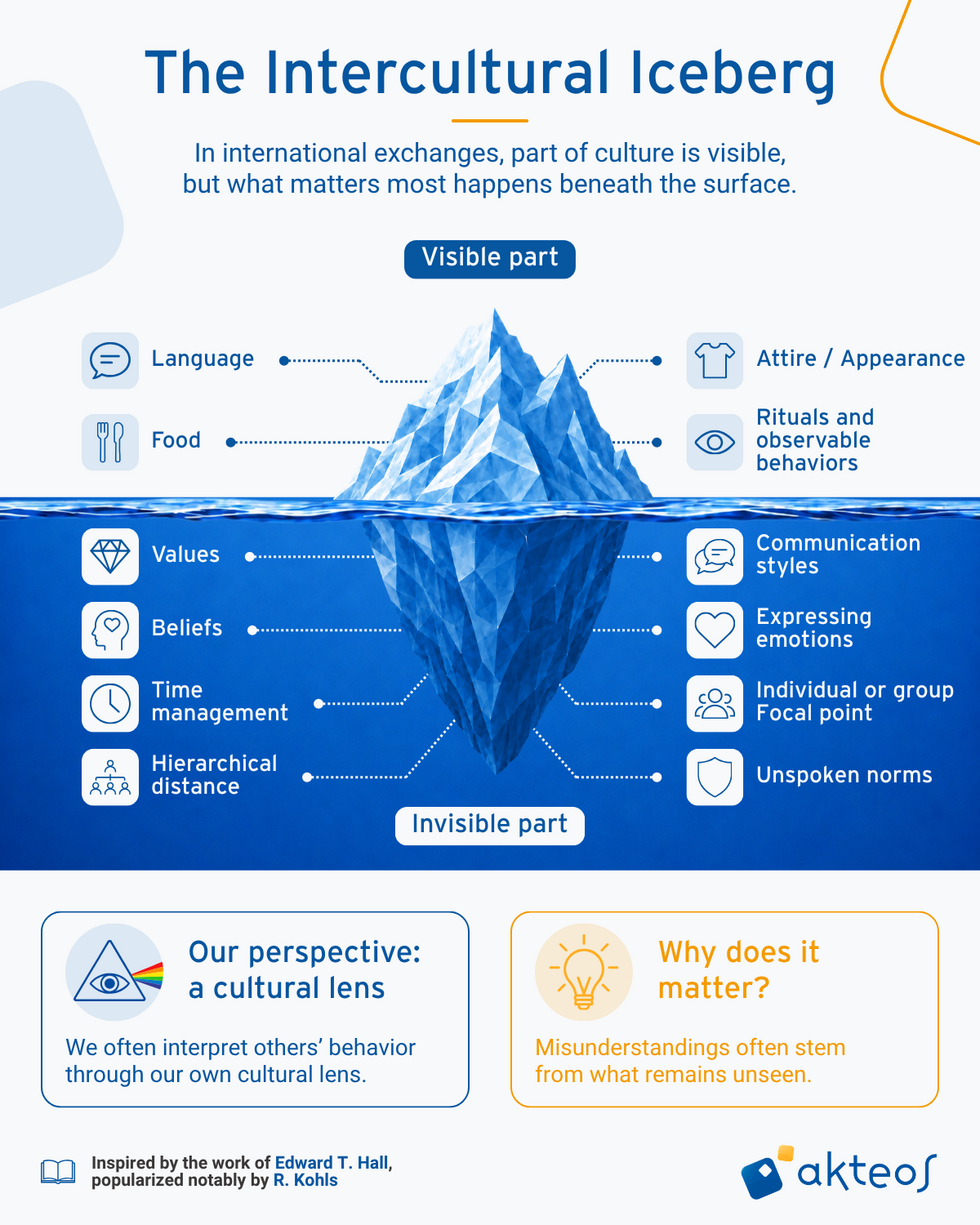
The intercultural iceberg model compares a culture to an iceberg: a small visible part (language, codes, behaviors) and a large submerged part (values, beliefs, implicit norms) that explains most behavior.
The image is easy to remember. Like an iceberg, a culture only shows a small part of itself above the surface. Most of it stays submerged, invisible at first glance, and yet it is this hidden part that shapes behavior the most.
The Visible Part: What You See Right Away
It covers everything that can be observed from first contact: the visible part of a culture is language, food, dress, along with rituals and observable behaviors. It is the easiest part to spot, but also the least decisive when it comes to understanding a culture.
The Invisible Part: What Explains the Most
Below the waterline lies the invisible part: values, beliefs, how time is managed, and power distance. It also includes communication styles, how emotions are expressed, an individual or collective frame of reference, and the unspoken norms that no one states but everyone is expected to know.
Some versions of the model distinguish two levels within this submerged part. Just below the surface lie unwritten rules, such as how to take the floor in a meeting or what physical distance feels appropriate: people can become aware of them by observing and naming them. Further down, values and beliefs remain largely unconscious. It is this intermediate level that intercultural work makes explicit first.
Why the Invisible Part Causes the Most Misunderstandings
This is where most intercultural misunderstandings begin. Not in what is different and visible, but in what stays implicit and that everyone interprets on the spot through their own frame of reference. The same silence in a meeting can signal respect in one culture and disagreement in another. This mechanism echoes coconut and peach cultures, another framework, popularized by Fons Trompenaars and Charles Hampden-Turner, that sheds light on relational misunderstandings at work.
Two Essential Nuances to Keep in Mind
- A culture is not a fixed block. It evolves, sometimes contradicts itself, and coexists with other influences. The iceberg offers a snapshot at a given moment, not a final truth.
- An individual can never be reduced to their culture. The model helps form hypotheses and stay curious, never to box a person into a category.
Start by Making Your Own Iceberg Visible
Real intercultural work often starts with self-awareness. Before trying to decode someone else’s iceberg, you first have to make your own visible. That is the whole purpose of Akteos’ Cultural Profile, one of the two components of the Nomad’ Profiler© alongside the Country Packs, which helps each person identify their own reference points before comparing them to those of others.
How to Use the Intercultural Iceberg Day to Day
Observe: do not stop at what is visible. A surprising behavior often hides a value or a norm that cannot be seen.
Ask: when faced with a situation you do not understand, look for the submerged dimension rather than judging. Open questions help surface what stays implicit.
Compare: rely on a shared reading grid, such as the Nomad’ Profiler©, to objectify cultural gaps without value judgment.
Akteos’ Intercultural Communication and Intercultural Management training courses help teams surface what stays below the waterline.
A Founding Concept, in Perspective
The intercultural iceberg is one of the founding concepts of intercultural theory, popularized from the 1970s onward. Its use is sometimes criticized, for two main reasons. First, it can suggest that the visible part is superficial, when a ritual or a dress code can carry a great deal of meaning. Second, it tends to tie a person to a single culture, when everyone combines several affiliations: national, professional, generational, or linked to their company. Other readings exist as a complement, such as the concept of the rhizome borrowed from the philosophy of Gilles Deleuze and Félix Guattari (A Thousand Plateaus, 1980). It envisions culture as an evolving network of connections rather than a vertical block: an engineer who grew up between two countries, trained in a third and works in an international team draws on several influences at once. The iceberg keeps its full value as a first level of reading: these approaches enrich it, they do not replace it.
Looking to set up a tailor-made project? Contact us!
FAQ: Common Questions About the Intercultural Iceberg
The model has no single author. It draws on anthropologist Edward T. Hall’s work on the hidden dimensions of culture (The Silent Language, 1959; Beyond Culture, 1976). The iceberg image then spread in the 1970s, notably through Robert Kohls, in preparing people to work abroad.
Attitudes toward time, relationships with hierarchy, ways of expressing disagreement, or the importance given to the relationship before the task. For example, whether or not to contradict a manager in a meeting belongs to this invisible part. These elements cannot be seen, yet they strongly shape behavior at work.
The iceberg offers a vertical reading: the visible and invisible layers of a given culture. The rhizome, borrowed from Deleuze and Guattari, rather describes a network of multiple influences that intersect and evolve. The two approaches are complementary: the iceberg helps identify what is hidden, while the rhizome reminds us that each person combines several cultures.
About the author

As a specialist in Cross-Cultural Management and Diversity & Inclusion, Akteos helps companies to master risks linked to cultural differences and to value diversity as an asset by developing the skills of managers and their teams.