


Coconut and Peach Cultures: A Key to Intercultural Communication
Why does one colleague seem “cold” and another “too familiar”? Coconut and peach cultures describe two ways of building professional relationships. Here is how to decode them to cooperate better.

The same behavior can be read in two opposite ways depending on the culture. What signals respect to some comes across as distance to others. To make sense of these misunderstandings, two researchers, Fons Trompenaars and Charles Hampden-Turner, offered a telling image: the coconut and the peach. This reading ties in with Akteos’s Nomad’ Profiler, which decodes how cultures approach relationships and trust.
What is a coconut or peach culture?
These are two models for managing the boundary between the professional and the private spheres. They describe how quickly trust is built and how much room personal life is given in a working relationship.
Coconut culture
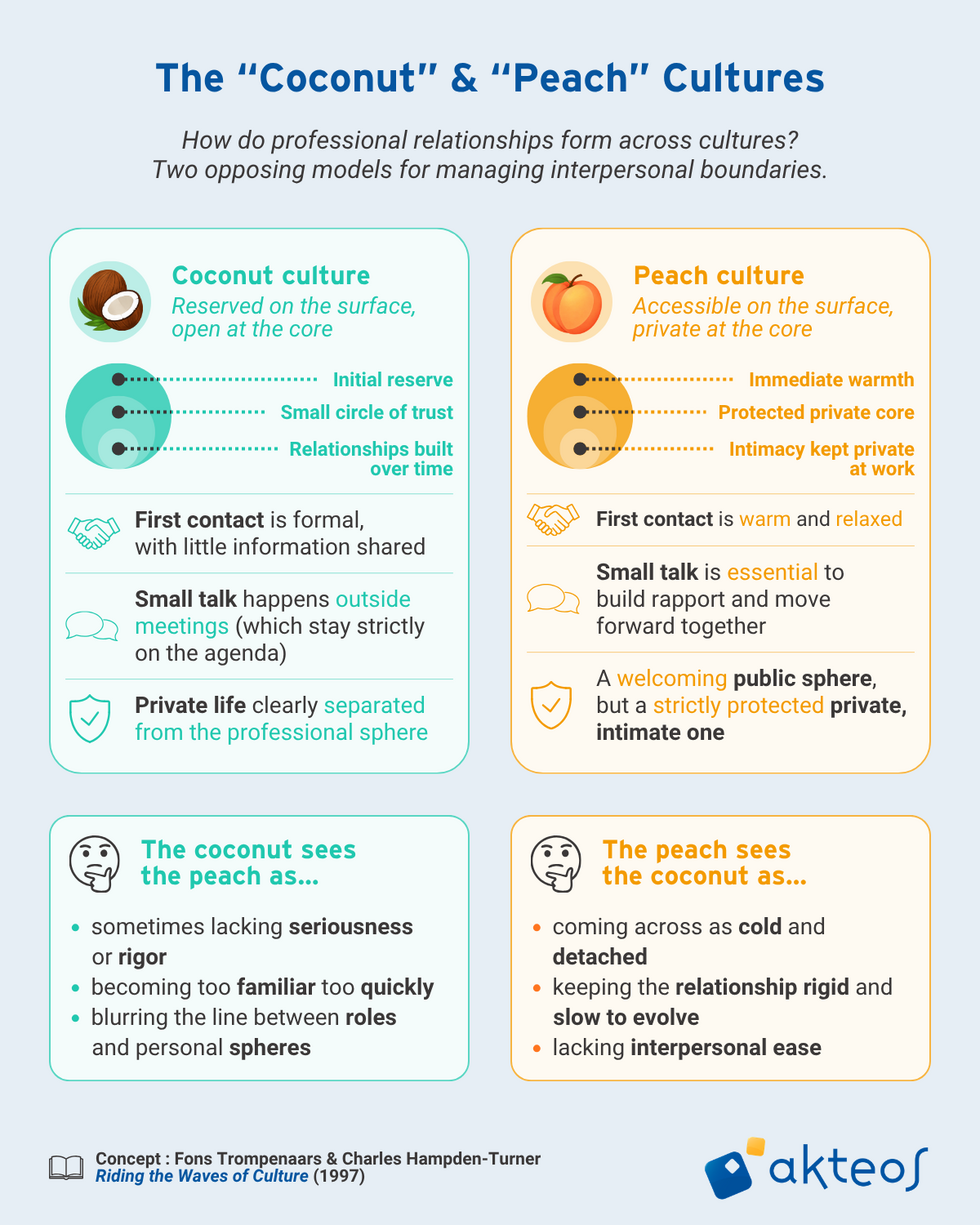
Hard on the outside, soft on the inside. First contact is formal, and little personal information is shared upfront. The relationship is defined by role, rules, and hierarchy. Trust is earned slowly, but it is solid and lasting. This pattern is common in Germany, France, Japan, and the Nordic countries.
Peach culture
Soft on the outside, protected core. First contact is warm and relaxed, and first names come naturally. Small talk is essential to build rapport before moving forward together. Warmth is immediate, but the intimate sphere stays protected. This pattern is common in the United States, Brazil, Australia, and Latin America.
Why these two cultures misunderstand each other
The misunderstanding comes from a simple reflex: each person judges the other by their own codes. Someone from a coconut culture sees the peach as too familiar, sometimes unreliable, blurring the line between roles and personal spheres. Someone from a peach culture sees the coconut as cold, distant, even uncommitted to the collaboration.
Neither reading is correct. These are two equally valid relational logics that simply give a different weight to the relationship and to the task. The same mechanism appears in other frameworks, such as Edward Hall’s high-context and low-context cultures.
How to cooperate across coconut and peach cultures
Understanding the model is not enough: you also need to adjust your day-to-day reflexes. Three concrete levers help smooth cooperation.
Decode: do not read a counterpart’s reserve or warmth as a signal about the quality of the relationship. A formal handshake is not a rejection, and using first names right away is not over-familiarity.
Adapt: adjust your style without giving up your values. With a peach culture, a few minutes of small talk set the stage. With a coconut culture, a more formal tone at first contact is appreciated.
Capitalize: combine the strengths of both styles. Structured rigor secures commitments, while relational agility speeds up cooperation. A team that brings both together has a real asset.
Cultural agility means adapting without losing your own flavor. Akteos’s Intercultural Management and Intercultural Communication training help your teams decode these codes.
Would you like to set up a customized project? Contact us!
About the author

Driven by a desire to build bridges between cultures, Lisa Deschaseaux-Ramaye is Communications and Digital Learning Manager at Akteos. She designs and oversees content aimed at promoting cultural diversity and raising awareness of intercultural issues.