


USA, Mexico, Canada: Intercultural Insights Behind the 2026 World Cup
Akteos decodes what football reveals about work cultures in the United States, Mexico and Canada: management, emotions, diversity, decision-making and intercultural cooperation.
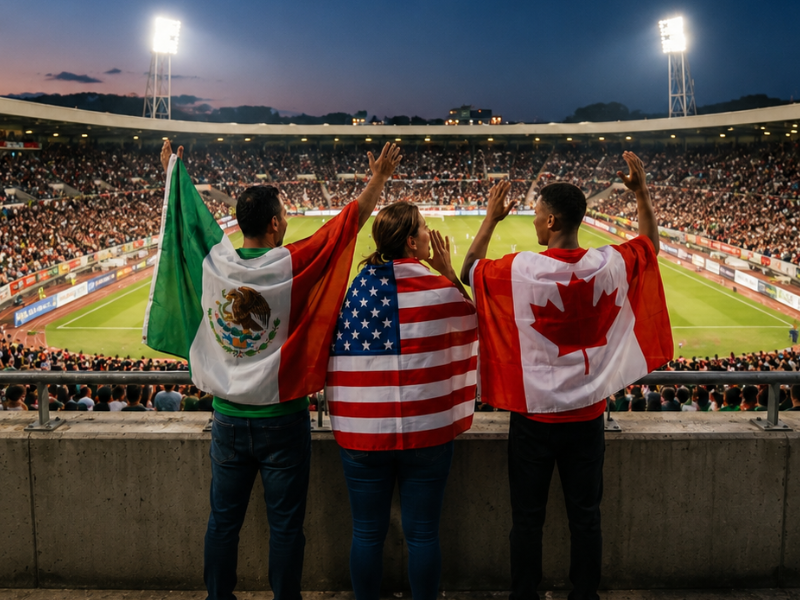
Note: In this article, “football” refers to the eleven-a-side game played in most countries around the world, also known as “soccer” in the United States and Canada by both French and English speakers. In these two countries, the unqualified term “football” refers to American football. We use “football” and “soccer” depending on the context.
This article offers an intercultural perspective on the event and does not aim to address in detail the political or economic issues surrounding it.
On June 11, 2026, the Azteca Stadium in Mexico City will host the opening match of the FIFA World Cup. Forty days later, the final will take place at the New York New Jersey Stadium. Between these two fixtures, 104 matches spread across 16 cities will cross three countries, three cultural systems, three radically different ways of living and working together.
This edition marks a first in FIFA history: never before had a men’s World Cup been co-organised by three countries. This logistical detail speaks to something profound about North America: three geographically close but culturally contrasting spaces, three immigration societies that have learned, not without friction, to cooperate on a large scale. This is precisely what companies operating in the USMCA zone (United States-Mexico-Canada Agreement) do every day, the North American trade agreement that came into force in 2020, replacing the historic NAFTA (North American Free Trade Agreement).
We did not want to write the usual article about stereotypes such as “Mexicans are passionate, Americans are fans of sports entertainment, Canadians are polite”. What interests us here is what each culture’s relationship to sport reveals about its professional codes, and what managers of mixed North American teams can learn from it.
1. Emotion in sport: three ways of feeling it
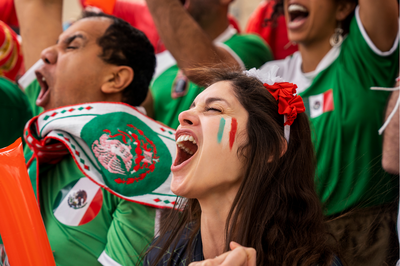
Let us start with an anecdote that went viral on social media during the 2018 World Cup. When Mexico scored its first goal against Germany, seismic sensors reportedly recorded slight vibrations in Mexico City, attributed by a local monitoring institute to the celebrations of Mexican supporters. Football as a seismic force: there is hardly a better image of positive Mexican emotional expression.
In the United States, sports emotion follows a different register: that of orchestrated spectacle. As Sylvie Day, US intercultural expert, points out, the spectator does not merely attend a sporting contest: they consume a complete narrative blending competition, patriotism, music, marketing and pop culture. The Super Bowl, the iconic event of American sports culture, invented the “entertainment event” model: a ritual that far transcends the world of sport with its mix of competition, entertainment and commercial power, making it something of an unofficial national holiday. Tens of millions of Americans watch it, including people who do not follow American football the rest of the year. Its defining moment remains the “half-time show,” the interval concert, which has become a global cultural event in its own right. Major brands invest enormous sums to produce humorous, emotional or spectacular commercials. You do not simply come to watch a game, you come to live an experience. Emotions are intense, but contained, as they do not come only from the stands: they are organised, calibrated, and conceived as a television experience. As in everyday life, positive emotions are strongly externalised, enthusiasm, celebration, encouragement, while negative emotions are more tightly controlled within a narrative of self-transcendence.
In Canada, the quintessential emotional ritual is called “Hockey Night in Canada”. Every Saturday evening since the 1950s, millions of Canadians watch hockey with focused collective restraint, before erupting when their team scores. Supporters can be vocal, though the intensity remains different from what is observed in Mexico. The emotion is very much there, and deep, but filtered through a cultural norm of low-key behaviour that values restraint over effusion. As Cécile Lazartigues-Chartier, Canada intercultural expert, points out: Quebec, a distinct society, experiences its passion for hockey with a great deal of engagement and vocal enthusiasm, yet another cultural difference for this province that is more “Latin” than the rest of Canada (ROC, Rest of Canada).
What this means in the workplace
When working with Mexican colleagues, as Isabelle Aliaga, Mexico intercultural expert, points out, relationships, conviviality and team spirit are essential dimensions. A meeting that is too technical, focused solely on objectives, neutral and “soulless,” may be interpreted as a lack of engagement, an absence of interest, or even of respect for the people and the group. Positive emotion, relational warmth and signs of attention are not peripheral elements of professional communication: they are expected components of it.
Isabelle Aliaga also notes that a few minutes spent building rapport at the start of a meeting are not wasted time: they help to create the conditions for cooperation. Greeting each person, asking for news, creating a warm atmosphere and showing genuine interest in people builds a climate of trust and engagement in which exchanges will flow more smoothly and adjustments will come more easily. This does not mean unfiltered emotion: enthusiasm, conviviality and relational warmth are welcome, but irritation, anger or direct public confrontation can be very badly received. These can cause everyone to lose face, be interpreted as a lack of composure or respect, and undermine both the interpersonal relationship and the harmony of the group.
When working with American colleagues, Sylvie Day observes that enthusiasm is highly valued in the workplace. Expressions such as “it is amazing,” “awesome” or “good job” are part of daily life to motivate and inspire teams, while negative emotions are not acceptable, as they are often seen as counter-productive, or even as a lack of self-control or professionalism. Emotion is a genuine element of social and professional competence, closely linked to the ability to create a positive dynamic within the group.
When working with Canadian colleagues, understatement is a form of politeness and honesty: not overdoing it is a way of respecting the other person. Cécile Lazartigues-Chartier notes that there is indeed an Anglo-Saxon way of approaching professional relationships with restraint, without emphasis or pathos, getting straight to the point with simplicity and pragmatism, in a search for consensus. However, Canada’s multicultural reality and Quebec’s intercultural dynamics mean that this Anglo-Saxon modus operandi is coloured by the nuances of immigrant cultures. Quebec, once again a distinct society, proves to be more “Latin” than the rest of Canada in its professional communication styles.

2. Three models of integration, one shared challenge of diversity
The three host nations of the 2026 World Cup are immigration societies. But their models of integration differ significantly, and this can be read in the history of their national sports.
.jpg)
In the United States, soccer was long perceived as an “ethnic” sport, the game of Italian, Scottish and Ukrainian immigrants in the first half of the twentieth century, before becoming associated with Latin American communities from the 1970s onwards. Sylvie Day points out that it also became, in middle-class suburbs, a family and school sport often associated with girls. The massive development of women’s soccer following Title IX (1972), which promotes women’s sport in universities, reinforced this image. Figures such as Mia Hamm transformed women’s soccer into a positive symbol of educational and family achievement.
The American “melting pot” took several decades to fully integrate soccer into its popular culture. Despite steady progress, the American sports landscape remains largely dominated by American football (NFL), basketball (NBA), baseball (MLB) and ice hockey (NHL). The launch of MLS (Major League Soccer) in 1996 nevertheless marked an important milestone by giving soccer a lasting and credible professional structure. Its development can also be attributed to a gradual adaptation to American cultural codes, particularly through the staging of the sporting spectacle and the experience offered to spectators. This evolution illustrates American society’s capacity to integrate outside influences while transforming them according to its own cultural references. That said, although soccer’s popularity has grown considerably, particularly among younger generations and in several major cities, it has not yet claimed a central place among the sports historically embedded in American sporting identity, as illustrated by the following testimonials gathered in the field by Sylvie Day:
Donna, from New York State:
“Soccer is starting to gain in popularity here. Our family loves English soccer. It’s true that it is nowhere near as popular here as it is in the rest of the world.”
Ted, from New York State:
“In our office of around fifteen men, only Luis is talking about the event, and he is from Ecuador.”
Andy, from New York City:
“I haven’t heard anyone talking about the World Cup. I don’t even know if the final is taking place here. Soccer is still not very popular. The Knicks are in the NBA finals, so that’s what everyone is focused on.” (The New York Knicks are a professional NBA basketball team.)
Donna adds:
“We follow English soccer like some of our friends. I don’t know anyone who closely follows American professional soccer. The level there is lower. If we lived in a city with a professional team, we’d probably go and watch it.”
Tom, from Los Angeles:
“I notice that LA is finally starting to put up signs and advertisements in public transport, but it really only started in mid-May. The pace has been slow these past few months, but I have a feeling that the bars and restaurants will be packed from the very first match.”
Sylvie Day also notes that the United States’ desire to host the 2026 World Cup is not purely for sporting reasons: while the event is certainly a cultural and geopolitical issue, it is above all an economic one. Numerous debates are ongoing around the exorbitant prices of tickets, accommodation and transport.
John testifies:
“Unfortunately, I won’t be going to any matches. The prices are extremely high and unrealistic for a two-hour game. I attended the 2018 World Cup and prices were much cheaper. It’s a shame, because I was really hoping to go.”
_(cropped).jpg)
New York’s mayor, Zohran Mamdani, has launched several initiatives, including the creation of a “1,000 discounted tickets” programme, sold at 50 dollars to New York residents through a lottery. The programme also includes free return bus transport and the creation of free fan zones in order to reduce the overall cost of the experience for supporters.
Thus, as Sylvie Day notes, the US sports model, largely built on the commercial and marketing valorisation of the sporting experience, risks coming into tension with the more popular vision of football held by many international supporters. Furthermore, the fact that this World Cup takes place in 2026, the year of the 250th anniversary of American independence (1776-2026), gives it a strong symbolic significance and makes it a powerful narrative and political lever. The American press reports measured enthusiasm as the event approaches, citing in particular the high cost of tickets, the difficulties some supporters face in obtaining visas, the long distances between host cities, and a political climate that may deter some foreign visitors. The New York Times ran the headline on June 3: “Why does no one care about the World Cup this year”.
In Canada, the official model is that of the “multicultural mosaic,” a state policy since 1971 that recognises and values cultural identities rather than melting them into a common crucible. Cécile Lazartigues-Chartier underlines the importance of a note on Quebec, a distinct society, which enshrines interculturalism as the foundation of integration. Two visions have indeed been embedded in law: on one side the Canadian Multiculturalism Act (1988) at the federal level, on the other the Act on integration into the Quebec nation (2025) at the provincial level. Two different political visions, two very different intercultural dynamics. Ice hockey, the national winter sport since 1994, remains poorly representative of Canadian diversity in its structures, but is gradually opening up: “Hockey Night In Canada: Punjabi Edition,” launched in 2008 on OMNI Television, offers commentary in Punjabi for South Asian communities. Soccer, meanwhile, is structurally more diverse, driven by recent waves of immigration.
In Mexico, the question of integration arises differently. As Isabelle Aliaga explains, the country did not build its national narrative around immigration in the same way as the United States or Canada, even though it has been, at various points in its history, a land of welcome and migration: Spanish, French, Italian, German, Chinese, Japanese, Lebanese and Jewish communities, Spanish Republican exiles, Latin American political refugees, among others. The difference therefore lies less in the absence of immigration than in the dominant national narrative, more structured around Mexicanness, a strong sense of cultural belonging and a heritage that is at once pre-Hispanic, colonial and mestizo, even if Mexican reality is obviously more complex.
As Isabelle Aliaga emphasises: “Mexico brings to this World Cup a singular pride: that of a country which does not separate sport from culture, memory and collective identity. From the Azteca Stadium to Mexico City’s museums, from the pre-Hispanic ball game to contemporary art, football becomes a way of saying to the world: Mexico welcomes, but it also tells who it is.” Mexicans like to recall that the earliest traces of the ball game date back approximately 3,600 years in Mesoamerica. For the 2026 World Cup, the “Corredor Cultural Mundialista” illustrates this desire to connect sport, memory and cultural outreach: museums, galleries and public spaces in Mexico City will offer exhibitions on football, pre-Hispanic archaeology, contemporary art, design, folk art, science and the social dimensions of sport.
Fútbol thus plays less the role of a melting pot than that of a common denominator, a shared language beyond social and geographical divides. And for a large part of the Mexican diaspora settled in the United States, El Tri functions as a powerful transnational identity bridge.
What this means for DEI/EDI initiatives
As Cécile Lazartigues-Chartier points out, the French-speaking world generally uses the acronym EDI (Equity, Diversity, Inclusion) where English speakers talk about DEI. This difference in terminology is itself revealing of a distinct cultural approach.
French multinationals deploying diversity policies in their North American subsidiaries must integrate these three distinct models. What is expected in Toronto, Montreal or Vancouver (explicit policies, quotas, institutional recognition of diversity) is not necessarily what works in Houston or Monterrey. In the United States, Sylvie Day notes that diversity policies are built on the explicit recognition of identity groups and on ethnic and gender representation. Americans often identify as “hyphenated Americans,” meaning citizens who combine their American identity with another cultural, ethnic or national origin: Italian-American, Mexican-American, Irish-American, Chinese-American, African-American, etc. Perhaps the most striking example is the fact that it is common, in professional job applications in the United States, to find a section related to the candidate’s ethnic background. Intercultural training is therefore not a luxury in this context: if companies do not take these nuances into account, they expose themselves not only to significant misunderstandings, but also to reputational and legal risks related to discrimination and inclusion.
3. Individual heroes and team collective: a variable balance

In US sports culture, the figure of the MVP (Most Valuable Player) is central. Each professional league rewards its top individuals: personal statistics are tracked, commented on, and monetised. But Sylvie Day points out that the American ideal is not that of an isolated star: the great player is above all someone capable of elevating the collective, embodying leadership, and transforming their team’s destiny. This logic is particularly visible in baseball, which stages moments of individual responsibility in service of collective success. The batter faces the pitcher alone, but plays with the aim of pushing beyond their limits to help their team win. This is indeed an illustration of the American vision of the collective, founded on individual responsibility.
.jpg)
In Mexico, the relationship is reversed in its symbolic representation. El Tri, the Mexican national team, is a near-sacred entity that transcends all social divides. Major individual stars do exist (Hugo Sánchez in the 1980s, Rafa Márquez in the 2000s, Hirving Lozano more recently), but they always fade behind the shirt. In Liga MX, it is club identity, Club América, Chivas, Cruz Azul, that structures loyalties, far more than the status of any individual star.

In Canada, the celebrated sporting figure is that of the humble leader. Sidney Crosby and Connor McDavid, two of the finest hockey players of their generation, are admired for their excellence but also, and perhaps above all, for their public restraint. Individual ostentation is poorly regarded in Canadian culture, whether English-speaking or French-speaking Quebec. As Cécile Lazartigues-Chartier aptly puts it: “on this point, the two solitudes come together on the ice”: top performers are expected to let their results speak for themselves.
What this means for management
In the United States, explicitly recognising individual performance AND collective contribution is not contradictory: the two coexist and must coexist in managerial discourse. Sylvie Day observes that publicly praising a colleague, highlighting their results, or institutionalising practices such as “employee of the month” serves as much to recognise the individual as to reinforce collective cohesion. This logic rests on the idea that visible positive feedback promotes motivation, engagement and group dynamics.
When working with Mexican colleagues, as Isabelle Aliaga explains, team identity takes precedence over individual performance. However, individual recognition remains important: it is best expressed within a collective dynamic. Singling out one colleague too conspicuously can create discomfort if it gives the impression of overlooking the support, the relationship, or the contribution of the group. In practice, Isabelle Aliaga recommends that a personal one-to-one recognition is often preferable: it allows someone to be strongly valued without creating public awkwardness, while preserving group harmony. In a collective meeting, rather than congratulating Carlos directly and exclusively, it will often be more appropriate to say: “Congratulations to the whole team that contributed to this success, and congratulations to Carlos for their key role in this achievement.” This makes it possible to recognise individual performance without undermining collective dynamics.
When working with Canadian colleagues, public modesty is not a sign of lack of ambition, and overly ostentatious celebrations can be perceived as a lack of class. Cécile Lazartigues-Chartier notes, however, that Canada does not quite exhibit the “tall poppy syndrome” of Australia or Britain: proximity to the United States confers an acceptance of individual success, provided it remains collegial and restrained. What matters above all is consensus and social cohesion. As she puts it: “It is better to be wrong together than right alone.”

4. Performance and strategy: three paths to results
The United States invented professional sport built heavily on data. Every performance is measurable, every decision can be challenged by data, every coach reasons in terms of probabilities, optimisation and competitive advantages. This data-driven model, born in the American leagues, is now exported to world sport. Sylvie Day notes that the massive use of video, statistics and regulatory mechanisms such as the “salary cap” (a wage ceiling limiting franchise spending) reflects a culture in which performance must be objectifiable, quantifiable, and in which the most compelling argument is the figure.
In Canada, the rule is a value in itself. Hockey is a violent contact sport, but its penalties are extremely codified. Sylvie Day observes that American baseball is equally so, with a great many highly elaborate strategic rules, even if little action appears to be taking place on the surface. What distinguishes the two cultures is therefore not so much the existence of codified rules as their purpose: in the United States, codification serves performance and optimisation; in Canada, respect for rules and penalties is part of the culture of the game, fair play is a genuine norm rather than a stated ideal. This culture of respect for frameworks, which can be found in the very robust compliance processes of Canadian companies, is not rigidity: it is a form of institutional and social reliability.
In Mexico, the relationship to rules is mediated by the concept of viveza, a term to be handled with care in a professional context, as Isabelle Aliaga points out, who prefers the notion of situational, relational and collective intelligence. Viveza should not be understood as cheating or opportunism: it describes a capacity to learn on the ground, to observe, to mobilise the right relationships and to progress through experience rather than through exclusively formal frameworks. This agility is built on exchanges, mutual support and attentiveness to context: being sensitive to weak signals, capable of adapting quickly and seizing the opportunities that a situation opens up. In Mexican football as in business, the solution is often born in interaction and adaptation, not in the strict application of a protocol.
What this means for project management and decision-making
This importance placed on data does not stop at sport. In an environment where performance is constantly measured, compared and analysed, figures become a central decision-making tool. Sylvie Day notes that the American decision-maker will be more receptive to an argument supported by metrics, results or tangible evidence than to a line of reasoning based solely on intellectual or Cartesian coherence. A project manager who needs to convince teams based in the United States without any hierarchical authority must also bring concrete data in order to persuade and influence without authority. This reading echoes a classic distinction in intercultural studies between a more theoretical and conceptual approach on the French side and a more empirical and pragmatic approach on the American side.
With Canadian partners, respecting established processes is a condition of trust; bypassing them, even for a good reason, generates mistrust. That said, proximity to the United States gives Canadian partners an equally pragmatic, results-oriented approach, in which figures and data play an important role in decision-making. With Mexican partners, as Isabelle Aliaga points out, French procedural rigidity can be perceived as a lack of situational intelligence and relational and intellectual flexibility: the solution is built in dialogue, not in the application of the manual.

5. Three countries, one shared project: a lesson in intercultural cooperation
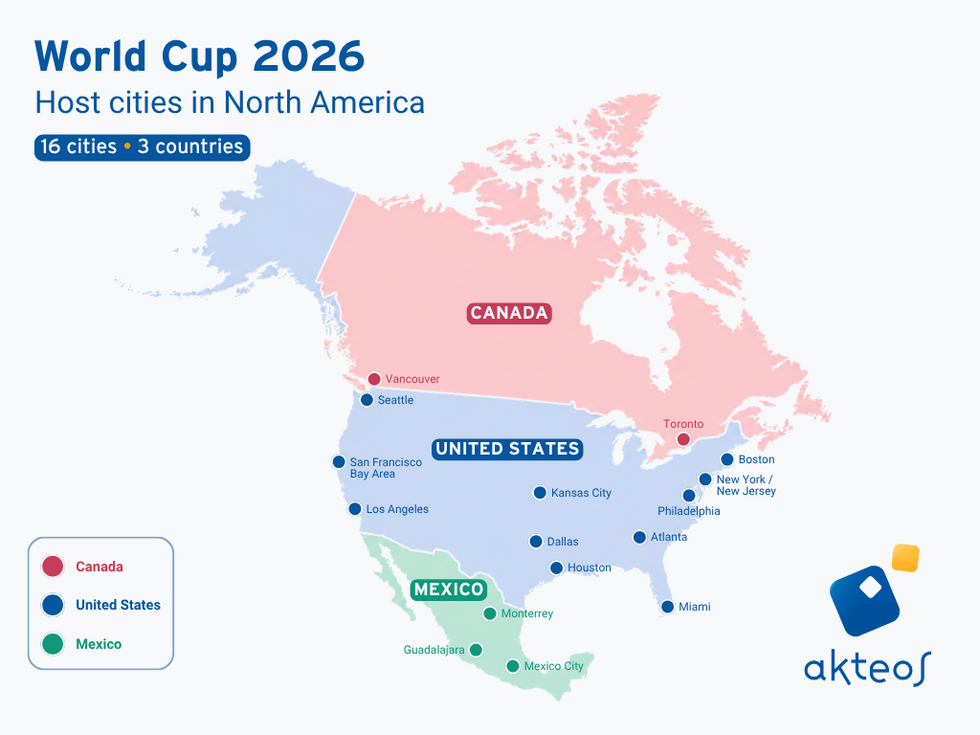
The organisation of the 2026 World Cup highlights an asymmetric distribution among the three host countries: 11 cities in the United States host the majority of matches (78), compared to 3 cities in Mexico and 2 in Canada (13 matches each). This distribution reflects a more significant organisational weight for the United States in structuring the event. At the same time, certain choices introduce a logic of balanced representation, such as the opening match scheduled in Mexico City, the final in New York, or the official ball “Trionda,” which incorporates the colours of all three countries.
These elements can be analysed as different ways of managing cooperation between partners of unequal size and capacity, a situation that is also found in the business world. For example, it sometimes happens that a French company acquires an American subsidiary whose revenue, workforce or market presence is greater than its own. This type of operation often raises significant intercultural challenges. Teams must learn to work together despite differences in professional practices, particularly in relation to hierarchy and decision-making processes, communication and teamwork. In this context, the challenge is less about imposing a single model than about building shared ways of working that are capable of leveraging complementarities.
This is not so different from what companies operating in the USMCA zone experience every day. The daily commercial exchanges between the United States and Canada are among the most significant in the world. Supply chains link factories in Monterrey, warehouses in Toronto and decision-making centres in Dallas. Cross-functional commercial teams navigate daily the cultural gaps between these three economic capitals that are geographically close yet significantly different in their professional codes.
What this means for French multinationals
Thus, the 2026 World Cup can be put into perspective with the challenges faced by French multinationals operating in North American environments. Managing a cross-functional Toronto-Dallas-Monterrey team means managing three work cultures simultaneously, with their differences in communication and emotional expression, particularly in the event of conflict and misunderstandings, in their relationship to performance, teamwork, decision-making and project management. What the three host countries do together for 39 days, companies do every day. And as with the 2026 World Cup, the success of the shared project depends less on erasing differences than on explicitly acknowledging them.
What the 2026 World Cup teaches us
The 2026 World Cup will be one of the greatest sporting events ever organised, both in terms of the number of participating teams and in its media, geographic and economic scale. It is a giant laboratory of interculturality: three nations that have agreed to carry together something that transcends each of them individually.
The joint organisation of the tournament already reveals certain potential intercultural tensions between the three host countries. Immigration policies, the relationship to sporting spectacle, supporter expectations, and issues related to diversity and discrimination are not approached in the same way in the United States, Canada and Mexico. The three countries do not share the same relationship to football: in Mexico, fútbol is a central element of popular identity; in the United States, soccer remains strongly integrated into the logic of sports business, entertainment and the event experience inherited from the major American leagues; in Canada, it occupies a more secondary place behind ice hockey.
Sylvie Day recalls that the American conception of sport as spectacle and economic activity is explained by a particular historical trajectory. Unlike many European countries where sport developed within an associative, educational or community framework, American professional leagues were built very early on a market logic. The rise of the media, from radio to television, reinforced this dynamic by turning sport into content designed to capture large audiences. The commercial logic is fully embraced and rarely set in opposition to sporting passion. The 2026 World Cup fits fully within this North American tradition of an event that is simultaneously sporting, media-driven and commercial.
We may therefore ask: what stadium atmosphere does FIFA wish to promote? How far should football be transformed into spectacle? What space should be left for local supporter cultures? How should different sensitivities around chants, behaviours or inclusion issues be managed? The competition thus constitutes a genuine laboratory of North American cooperation.
The dimensions we have explored, different styles of communication and expression of sporting passion, ways of cooperating and managing the collective, management of cultural diversity, approaches to valuing performance, the relationship to sport as industry or as popular culture, constitute essential operational variables for anyone who manages or works in a mixed team, negotiates a contract in Monterrey or deploys an HR policy in Toronto or New York.
The sport played, just like the discipline itself, is not sufficient to define a culture on its own, but it often reveals certain essential traits, such as those developed in this article.
About the author

An Akteos article, in collaboration with three intercultural experts.
Cécile Lazartigues-Chartier: Franco-Canadian, intercultural consultant and international development specialist, she spent 29 years in Montreal before returning to France. At the crossroads of arts, communication and strategy, she supports companies and individuals in their international adaptation challenges.
Sylvie Day: An intercultural consultant for twenty years, she lives interculturality on a daily basis within her Franco-American family. After ten years in the United States and experiences in Germany and the United Arab Emirates, she supports French and American professionals and multicultural teams to collaborate more effectively together.
Isabelle Aliaga: Born in Mexico, with 22 years of expatriation across five countries and a corporate career in audit and mergers and acquisitions, she has been an intercultural coach and consultant for over fifteen years. She supports executives, managers and organisations in their mobility and international cooperation challenges.